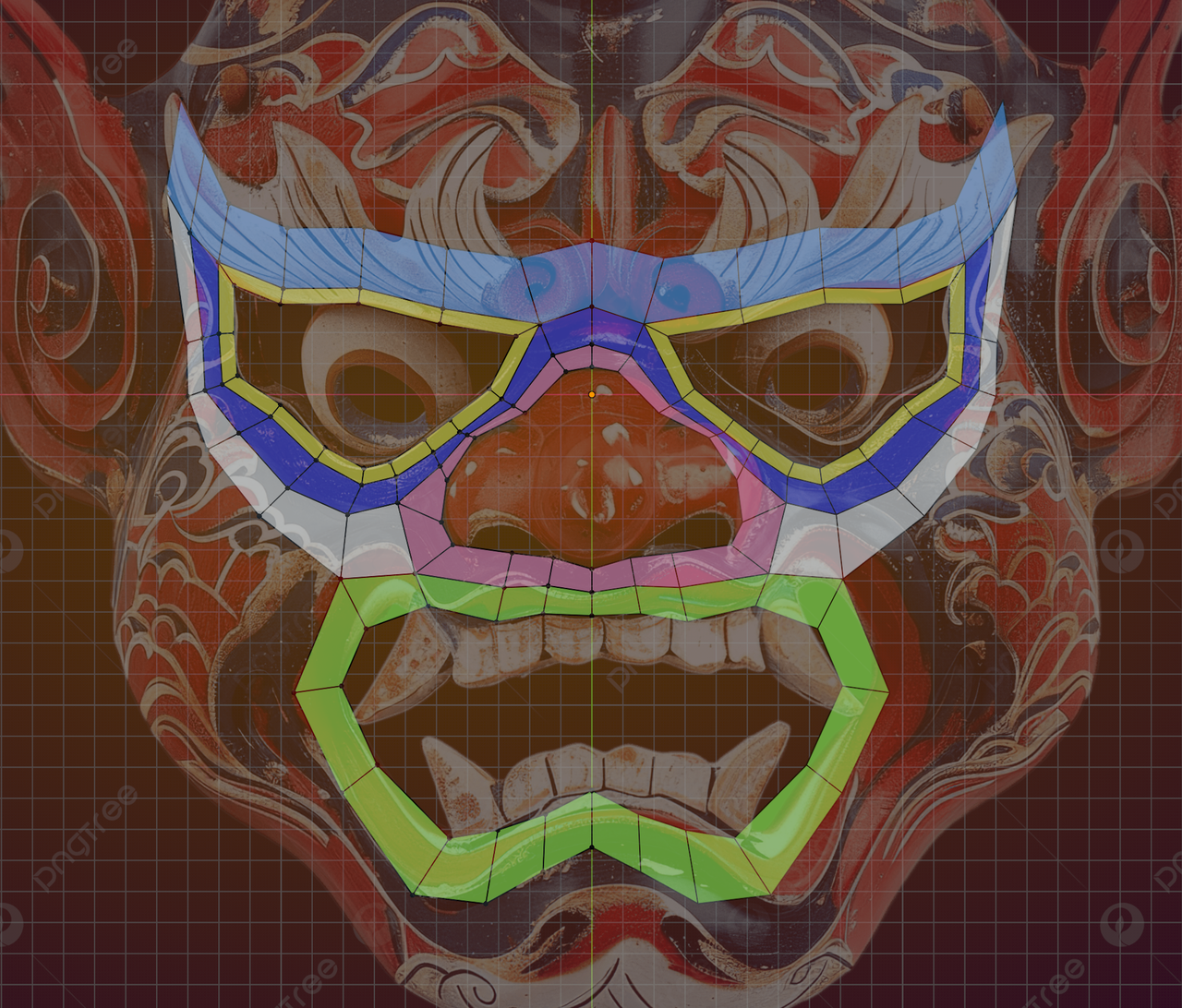
Hey so I did some topology practice I really wanted to try modeling an Oni mask! I feel like for my third thing modeling the topology turned out decent but now I'm stumped I have no clue how to take it from here. It feels too complex to do subd modeling and I tried that and just couldn't quite get it right I also tried just extruding one section at a time but then the sections don't really connect together smoothly. If I could get any help it would be greatly appreciated even though I got some good topology practice it would be a shame to lose all those hours and not finish the mask.


Hi Dillinger,
This seems like a model, that's screaming for Subdiv Modeling. And as you already noticed, your Topology doesn't support that.
Let me point out a few of the problems: the overall Mesh is far too dense, it has weird Edgeflow, 6-sided Poles, Triangles and N-Gons in inappropriate places:
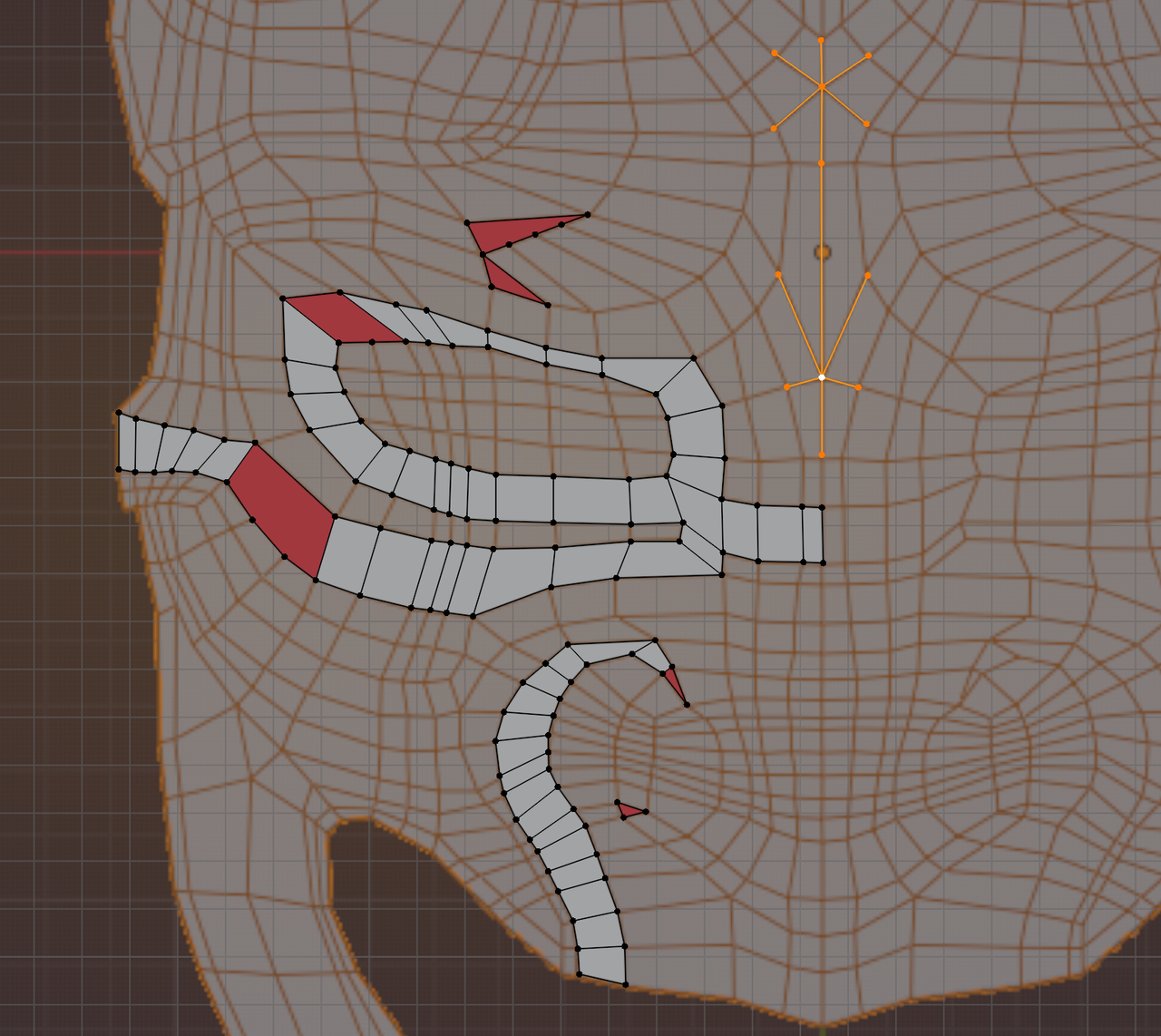
What I would recommend is, start with doing a few simpler re-Topologies first and then re-visit this Mask (Save this file, so you can look back at it later and see your progress).
Watch some Re-Topology Videos.
Maybe start here: https://cgcookie.com/courses/introduction-to-retopology (don't forget to do the excercise!)
Then there is this (specifically Chapter 3): https://cgcookie.com/courses/creature-modeling-for-production for organic Topology.
And if you feel confident enough after that, Chapter 3 of the Sci-fi helmet Course might be really helpful: https://cgcookie.com/lessons/brainstorming-topology for hard surface Topology.
The time you spent on your mask so far is not lost! Each time you do a re-Topology, you'll do it differently but you'll also get better.

Listen to Martin. This is perfect for Sub-D. Your mesh is way too dense and the object your choosing is not the easiest. Definitely start on something with a simpler form. The key to something like this is establishing the edge flow around the key parts as per Martin's comment above. Ideally you'll find a side reference so you can model this in xz AND y to establish the core form which will then make adding in details easier.
Also as Martin says this is definitely not a failure or wasted effort... it's great practice and you'll have learned a lot even if you don't yet realise it

This is exactly why Kent prefers to sculpt first and then retopo, instead of box modeling right from the start. When you just start to model, it's too hard to get the feel of how the object is going to be in 3D space, you model it flat and you're like ok, how do I push it back now? I can't just extrude it. So Kent usually goes into sculpt mode and just free flows it, making the mask as if he's drawing it n 3D space, no topology to worry about yet, it's just getting the shape as if messing around with a blob of clay. You have so much room for experimenting and getting shapes right this way.
After you have your sculpt ready and you're happy with it, you can easily now go in and just retopo it, you have much more brain bandwidth to plan how your loops wil flow and you have all the correct proportions of the model already. It is idea if you ask me. In the Sci-Fi Helmet course Kent takes this approach.
One more thing... it's definitely worth redoing this mask as a 2d quad only mesh - don't worry about edge loops or how you'll extrude it. Just being able to resolve all the edges so you have all quads across the whole mask in 2d is the first step.
I did a lot of this with more basic shapes so they matched when sub-d was applied. From here I'd extrude and bend/twist to see how well my mesh deformed. The useful shapes you want to concentrate on have both convex and concave curves with big gentle curves as well as tight sharp curves... highlighted in red. Once I found this too easy I tried joining two shapes across one axis... this gets a good deal harder but forces you to think in all 3 dimensions
Hey I appreciate you guys big time!! I absolutely bit off a tad more then I can chew this time but you guys gave me some good resources! I will absolutely save it and after learning more come back and try again.