Hi there,
I love that the add-on can help us check and fix objects that are not manifold so we can speed up the process to get to a final print.
I don't like, however, that in doing so we might be unaware of substantial changes that can happen my merging verts all around. If it's a tight clearance, or a very specific shape, things can get ugly on more complex models.
I guess I'm trying to make sure I have proper understanding of what manifold is, and how to turn on the "modeling for printing" switch in my brain.
Do I get it right that as long as all my faces have thickness and edges touch at least 2 faces I have achieved a manifold model? If I'm cautious on doing that, theoretically I can push the button on the add-on and nothing will happen, right?
If you have any words of wisdom of how to approach a design for optimal printing from the planning phase, or any extra resources to share, I'm all ears!
Thanks!!

Hi Nathi,
"...edges touch at least 2 faces..."
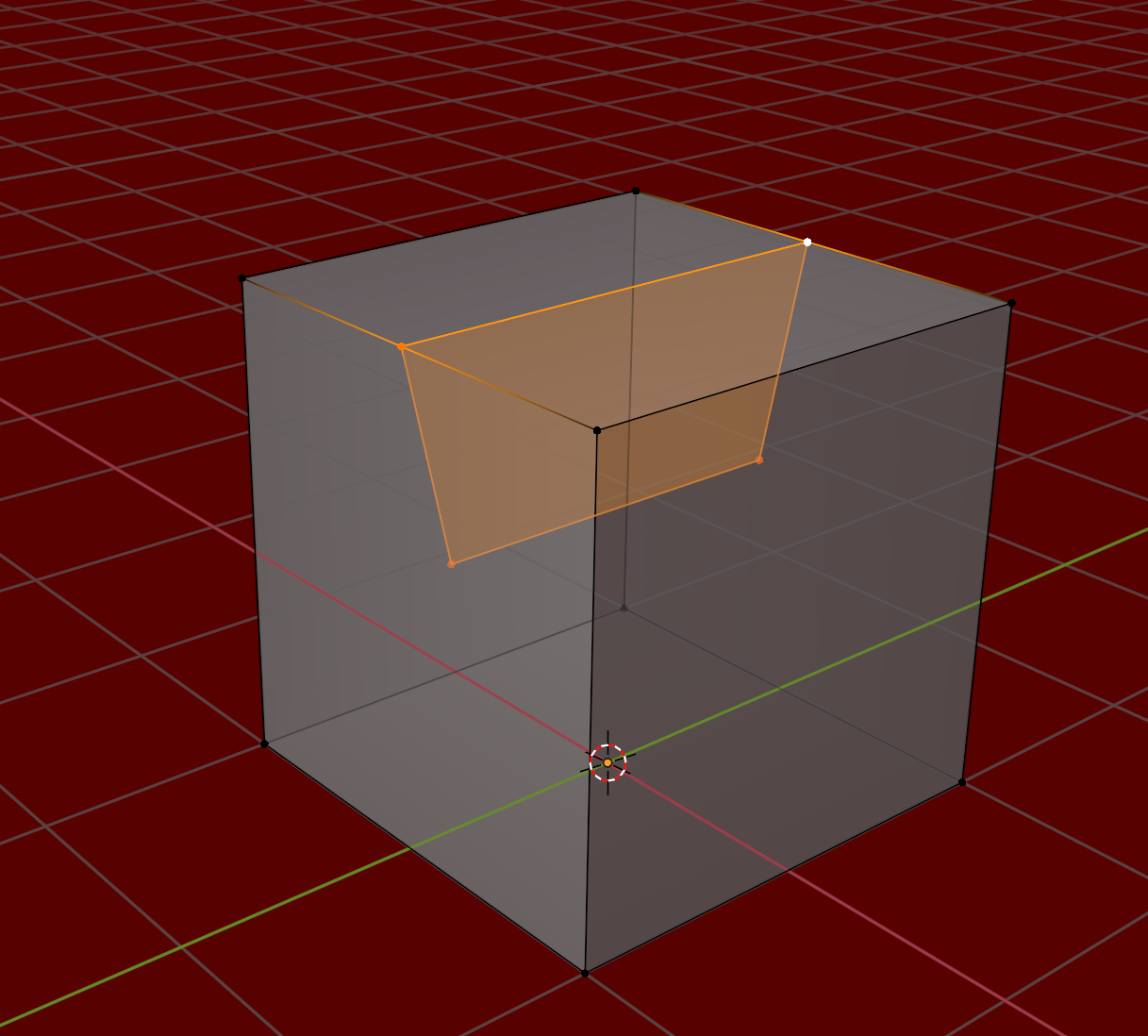
That should be all Edges are connected to exactly 2 Faces. But then that is also the only 'rule' that decides if a Mesh is Manifold. (There are of course other definitions of Manifold, but this is probably the simplest...)
But Manifold alone is not enough to be Printable (sharp angles, for instance are no good). The Addon checks for other problems as well, if I'm not mistaken.
Good point Martin! A third face connected there would probably just be an unwanted inner face giving us all sorts of issues for printing and not printing alike.
Maybe that answers one of my last questions then... whether the mesh can have 'loose parts' that intersect or not. Not sure if that would still make them "hermetically sealed".
That might be true...I don't know.
Here a fun fact, when a Mesh is Manifold, then the number of Vertices plus the number of Faces, minus the number of Edges is always 2.
The opposite is not true, unfortunately, Suzanne is not Manifold, but has 507 Vertices, 500 Faces and 1005 Edges and 507 + 500 - 1005 = 2.
Ha! That's a great visual Martin, thank you! But dang, how do you know those things? You and my husband would get along... he's the type that loves those fun facts.
And Omar, I'll hold Manny's story as true in my head. Lol.
Fair enough, that makes sense. Let's see what Porter says...