

Omar Domenech shares his story of turning 4-year-olds' drawings into 3D models.
When I First Saw The Drawings, I Thought: 'Easy'

The project came through a friend's 3D Printing Company called CUBIC.
I was asked if I could help out with a special project: a school wanted to turn children's drawings into 3D.
I live in Santo Domingo and the Art School that requested the assignment is called Altos de Chavón. When I first saw the drawings I thought it would be easy. My initial plan was to proceed vertex by vertex, drawing a contour of the form and extruding it, a simple cookie-cutter approach.
But after doing the first drawing it felt cheap and way too easy. And who wants the easy stuff, right?
I Heard Kent's and Jonathan's Voice, Saying 'Shame'
I decided that this way of doing it was not worthy of 4 years of training here on CG Cookie. I could almost hear Kent's and Jonathan's voices saying 'Shame, shame, shame!'

So I changed my approach to box modeling. This was more complicated, but hugely improved the quality of the result. Even though perfect quadded topology isn't necessary for 3D print, at least 99% of those models I made are perfect quads. It just felt right to make them that way.
It took me at least 6 full days of modeling to get all 20 drawings into fully 3D printable meshes; I kept the models watertight, watching out for non-manifold geometry.
The Sense of Accomplishment Was Worth It
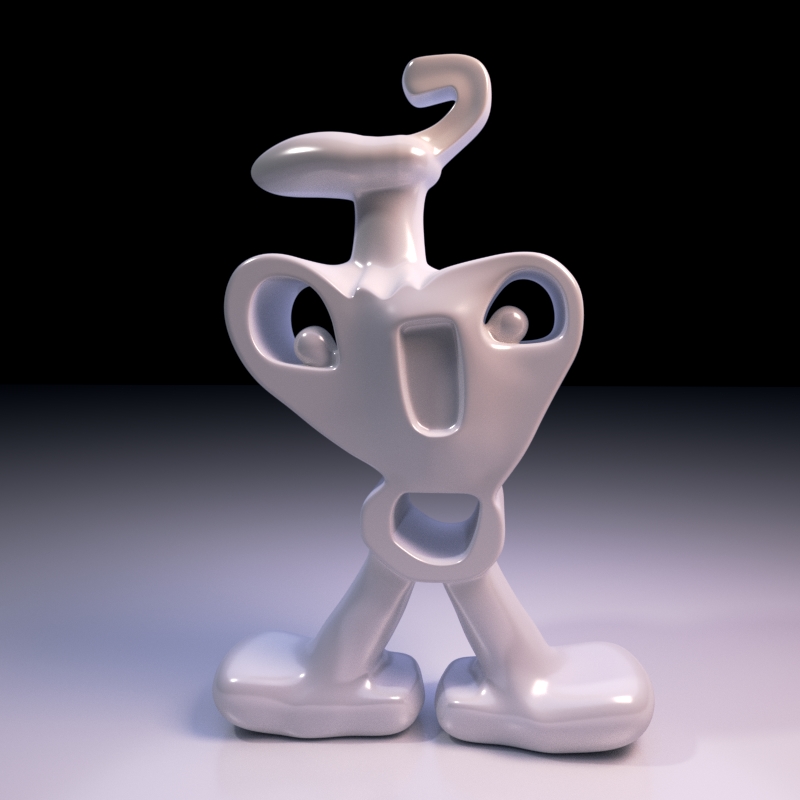
While interpreting the forms from 2D to 3D, the drawings had to go through a bit of change to work in real life, since the laws of physics didn't allow certain characteristics from the original drawings.
Sometimes, the legs were too skinny to support the model's weight, for instance. And I wanted all the models to be able to stand.
After the struggle of the creative process, the sense of accomplishment was so worth it, especially when sharing the work and getting great feedback.
Now, after being 3D printed and painted with textures, the artwork is being put on exhibit here in Santo Domingo.
The Art School is going to put them up on display and I hope a lot of people find them cute.
Perfect Architectural Models (PAM) is a well-versed Model Making in Dubai providing vast specialized model making services. Started in 1983, our journey of State-Of-The-Art models have set a proven record of not limited to Architectural models, Leisure models, Industrial models, Mechanical models, Marine models, Prototype models.
Do you realize that this is an entrepreneur's dream start up business right at your fingertips?
Fantastic idea
Thanks.
I've never done a tutorial but that has been in my radar for some time though.
I want to see a tutorial on how you make the promotional video! That was a really cool effect watching the models morph.
Thanks. I made the 3D models, the crafting and 3D printing was done by a co-worker. She hand painted all of them but I don't know what kind of paint she used.
These are just wonderful! I was wondering about how you went about the painting process? Are they hand painted and did you use acrylic craft paints or something else?
Alrighty, thanks. :)
Omar, that's so awesome! To just wrap your head around how to tackle this challenge; I loved reading this from you!
What an awesome gift for those children. It must have been exciting for them to see real forms of their work. This project is inspiring...